EMT Practice Test

1. Question Content...


Question List

Question1:
Referring to the above screen capture, if an administrator desires to change a specific AP into a Spectrum Monitor without assigning the AP to a new group, which menus could be used?

Question2: When an Aruba 6000 controller has two M3 modules installed, for which uses may the modules be used?

Question3:
As illustrated in the above diagram, a company has two campus locations and a building headquarters all located in different cities.
Following best practices, what would be the best way to construct mobility domains for the company?

Question4: Which descriptions of ClientMatch are accurate? (Choose two.)

Question5: Which functions can Adaptive Radio Management (ARM) perform on Aruba APs? (Choose two.)

Question6:
Referring to the diagram provided for this question, an employee brought an unauthorized AP from home and attached the LAN port to the cubicle Ethernet port. All Aruba APs and AMs as well as the employee AP are in VLAN 80 and within RF range of each other. No traffic from the wired or wireless network has passed through the unauthorized AP yet, but the AP began wireless broadcasts.
How will the Aruba system initially classify the employee's non-Aruba AP?

Question7: What is true about client match? (Choose two)

Question8: A client has not purchased the RF Protect license. Without this license what is still supported, in the basic OS?

Question9: Which of the following statements is true?

Question10: By default, which CLI based remote access method is enabled on Aruba controllers?

Question11: An administrator manages a wireless network for a hospital. Some of the medical equipment in the hospital can be affected by the wireless signals of the APs. The administrator needs to ensure that the APs' radios do not interfere with the medical equipment.
What can the administrator do to accomplish this?

Question12: Which may be applied directly to an VLAN interface? (Choose three)

Question13: Which command will show all client association history?

Question14: The Aruba Policy Enforcement Firewall (PEF) module supports source network address translation (src- nat).
Which is a use of this statement in an Aruba configuration?

Question15: Referring to the above screen capture,

Which tab tells you which licenses are installed on the controller?

Question16: A client Roams from one Local controller-1 to another Local controller-2. The controllers are in different subnets and L3 Mobility is enabled. How is the client traffic sent back to Local-controller-1?

Question17: What does Aruba's RF self-healing require to operate?

Question18:
A user logged in with the Captive Portal settings shown in the above screen capture.
What does the user need to do to logout?

Question19: Which describe "roles" as used on Aruba Mobility Controllers? (Choose two)

Question20: When configuring a server group containing 3 servers, a customer Chooses 'fail through mode'. What other configuration option has to be enabled on the controller for this to work with 802.1x authentication?

Question21: Referring to the diagram provided for this question, an employee brought an unauthorized AP from home, but did not attach it to the LAN infrastructure. The APs are in the VLANs as shown in the diagram. Only AP1 is within RF range of the employee AP.

By default, how will the Aruba system classify the employee's AP?

Question22: How can a role be assigned to a user, connected to an untrusted port, on a controller?
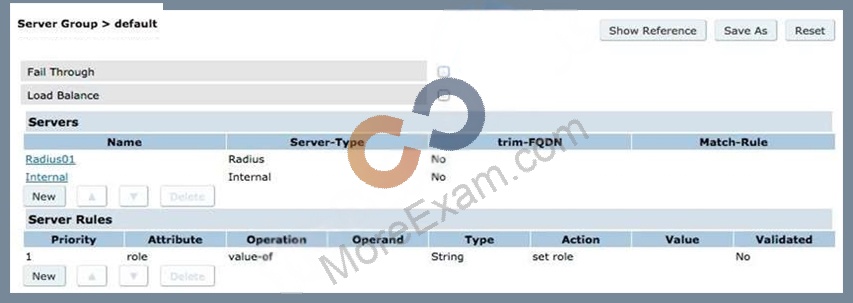
Question23:

Screenshots of the Captive Portal authentication profile and server group of a guest network are displayed above.
How was the user authenticated?

Question24: Which of the following functions cannot be configured in the WIPS wizard?

Question25: A customer forgot all passwords for a controller. What method could you use to reset the passwords?

Question26: A controller is provisioned in L3 Mode for Wireless Users. What must be configured on the controller to enable DHCP requests to an external DHCP server?

Question27: With CPSec disabled, which encryption protocol does a tunnel mode campus AP's use on client traffic?

Question28: An administrator creates a WLAN with an unmodified default AAA profile. What is the default role the user is placed in?

Question29: The reusable Aruba Controller wizards are accessible in what way?

Question30: Which ARM feature addresses the issue of sticky clients by moving clients to associate to APs with better
802.11 signal quality?

Question31: An Aruba controller can be accessed with which CLI based remote access methods? (Choose two)

Question32: When configuring ports in the Controller wizard, which of the following are NOT configuration options?
(Choose two)

Question33: Which of the following is an Aruba Layer 3 redundancy mechanism? (Choose two)

Question34: Refer to the exhibit.

An administrator manages a network in an office building. The Aruba APs in the network are configured for tunnel mode when they connect to the Aruba Mobility Controller in the data center. Each floor of the building has a separate VLAN for the wireless users. These VLANs are included in the trunk configuration from the Aruba Mobility Controller to the Router.
Which default gateway address should the wireless user receive with DHCP?

Question35: Which parameter does a Master switch use to determine where a provisioned AP should terminate its GRE tunnel?

Question36: A campus AP has been provisioned with a VAP in bridge forwarding and standard operation modes. Which of the following authentication types are supported? (Choose two)

Question37: As illustrated in the above diagram and screen capture, a wireless hacker injects messages into your network to detach a client from your Aruba AP.

What action should you take to identify and prevent the Intruder from connecting to your system?

Question38: (group8) #show ap active
Active AP Table
---------------
Name Group IP Address 11g Clients 11g Ch/EIRP/MaxEIRP 11a Clients 11a Ch/EIRP/MaxEIRP
---- ----- ---------- --------- ------------------- ----------- ------------------- AP1 building1 10.1.80.150 0 AM 0 AM AP2 building1 10.1.80.151 0 AM 0 AM
A user called technical support because they cannot see any of their APs in building one. You perform the
"show" command as illustrated above.
What can you conclude about these two APs from this output?

Question39: What can NOT be configured from the Aruba controller configuration wizards?

Question40: What are the Airtime Allocation Policy options for Airtime Fairness? (Choose three)

Question41: With Visual RF location tracking, show location history can be set for a maximum of?

Question42: Fast Failover has been implemented between Local 1 and Local 2 separated by Routers. During testing Local1 was disabled and all Campus APs backed up to Local 2 flawlessly. But the RAPs did not, they all failed.
What could be the cause?

Question43: With CPSec disabled, which tunnel protocol is used between APs and Controllers in an Aruba environment?

Question44:

The screen captures above show the 802.1X authentication profile and AAA profile settings for a VAP.
If machine authentication passes and user authentication fails, which role will be assigned?

Question45:

The screen captures above show the 802.1X authentication profile and AAA profile settings for a VAP.
If machine authentication fails and user authentication fails, which role will be assigned?

Question46: An administrator wants to create a customized captive portal firewall policy. Which required action must the administrator define for a firewall rule in order to redirect the initial web traffic to the controller to authenticate guest access?

Question47: Refer to the following configuration segment for this item.
ip access-list session anewone
user network 172.16.1.0 255.255.255.0 any permit
user host 172.16.1.1 any deny
user any any permit
An administrator wants users to have access to all destinations except 172.16.1.1. Based on the above Aruba Mobility Controller configuration segment, which statements best describe this policy? (Choose two)

Question48: A wired device is connected to an untrusted port on a controller. How can a role be assigned to the device?

Question49: A master controller fails in a master-local topology when centralized licensing is enabled. There is no standby licensing server configured. Local controllers do not have any factory installed licenses.
What happens to the local controllers in this situation?

Question50: An AP is not communicating with the controller. Upon investigation you find that the AP is not discovering its controller through DNS. Instead, it received a DHCP reply with option 43 specifying the SIP server's IP address. How do you resolve this problem?

Question51: Which of the statements below are TRUE regarding ARM's Spectrum Load Balancing feature? (Choose two)

Question52: An Administrator works in an Aruba-based network which has a master controller and three local controllers, centralized licensing is not in use. The administrator notices that no APs terminate on the master controller and concludes that the roles and firewall policies need to be to created and applied.
Which statement is true about the administrator's conclusion?

Question53: Which method can APs use to discover a controller?

Question54: When the controller is configured for Captive Portal and the user is only required to provide an email address for authentication, which option is configured in the GUI?

Question55: Which of the following statements is true of Spectrum Mode?

Question56: The Controller wizard enables which of the following controller clock configurations? (Choose three)

Question57: By default, how long will an AP scan a single channel when ARM is enabled?

Question58: A port firewall policy is applied to a trunk port that denies controller access. An "allow all" VLAN firewall policy is applied to VLAN 33 on the same port. A user connected to VLAN 33 on that port attempts to gain access to the controller. Which of the following statements is true?

Question59: When creating a firewall rule what are valid choices for the Service/Application field? (Choose three)

Question60: A server group is configured with two RADIUS servers. Load balancing is disabled but fail-through is enabled. Which statement is correct about this scenario?

Question61: Which of the following firewall rules allows a user to initiate an ICMP session to other devices? (Choose two.)

Question62: An administrator provides services to a university that has this environment:
There are two departments, named Department 1 and Department 2

Department 1 has its own mobility domain with one controller

Department 2 has multiple controllers configured in a second domain

The president of the university has a goal to roll out a new application next semester. The president wants to give users of this application the ability to roam between both mobility domains.
What should the administrator do to accomplish the president's goal in the most effective manner?

Question63: When configuring Captive Portal, which protocols are supported when accessing the Captive Portal?
(Choose two.)

Question64: Which of the following metrics does the ARM feature use to calculate the optimal channel and power level for Access Points? (Choose two)

Question65: Which actions does ARM (Adaptive Radio Management) perform? (Choose two)

Question66: As an admin/root user, what other type of role-based management users can be created on Aruba controllers?

Question67: Refer to the exhibit.

An administrator installs a new Remote AP (RAP) at a branch office. This RAP will connect to the corporate office's Aruba Mobility Controller in the DMZ from across the Internet. The administrator will need to make some rule changes on the firewall to allow for this connectivity.
Which protocol or protocols will the administrator have to permit on the firewall for the RAP to successfully connect to and send users' wireless 802.1X data to the corporate office?

Question68: In a campus environment, where are encryption keys sent or stored when users roam between tunneled mode APs on the same controller using 802.1X?

Question69:
In the above screen capture, the administrator notes that most of the configuration options are grayed out and have no action.
What is the cause of the problem?

Question70: Review the following truncated output from an Aruba controller for this item.
(example) #show rights logon
access-list List
----------------
Position Name Location
-------- ---- --------
1 logon-control
2 captiveportal
logon-control
-------------
Priority Source Destination Service Action
-------- ------ ----------- ------- ------
1 user any udp 68 deny
2 any any svc-icmp permit
3 any any svc-dns permit
4 any any svc-dhcp permit
5 any any svc-natt permit
captiveportal
-------------
Priority Source Destination Service Action
-------- ------ ----------- ------- ------
1 user controller svc-https dst-nat 8081
2 user any svc-http dst-nat 8080
3 user any svc-https dst-nat 8081
4 user any svc-http-proxy1 dst-nat 8088
5 user any svc-http-proxy2 dst-nat 8088
6 user any svc-http-proxy3 dst-nat 8088
Based on the above output from an Aruba controller, an unauthenticated user assigned to the logon role attempts to start an http session to IP address 172.16.43.170.
What will happen?

Question71:
In the above diagram, the system shows two Aruba access points and a wired user.
Which VLAN(s) do NOT need to be configured on link A between the L2 switch and router to support the wireless users?

Question72: A Remote AP provisioned with an SSID in the operational mode always has which one of the following characteristics?

Question73: An administrator deploys a Remote AP (RAP) at a branch office. The RAP connects back to an Aruba Mobility Controller at the corporate office over the Internet. The RAP broadcasts have two SSIDs:
employee and guest. Guest traffic should be sent directly to the Internet from the branch office and employee traffic, including Internet traffic, should be tunneled back to the corporate controller.
Which forwarding modes are suitable for this requirement?

Question74: When deploying Remote Mesh Portals, what is one of the purposes of the Mesh Private VLAN?

Question75:
In the diagram provided for this question, the client laptop is associated with the Aruba AP. The Aruba controller is configured to perform L2 switching for this SSID.
What will be the client laptop default gateway?

Question76: Which DHCP option does an Aruba AP use to identify itself as an Aruba AP when it acquires IP addressing information from a DHCP server?

Question77: Which method is NOT supported to provision an Aruba campus AP?

Question78: Which settings cannot be modified directly from a local controller?

Question79: The Master fails with Central Licensing enabled. What happens to the local Controllers?

Question80: ip access-list session anewone
user network 10.1.1.0 255.255.255.0 any permit
user any any permit
host 10.1.1.1 host 10.2.2.2 any deny
A user sends a frame with the following attributes:
Source IP: 10.1.1.1 Destination IP: 10.2.2.2 Destination Port: 25
Based on the above Mobility Controller configuration file segment, what will this policy do with the user frame?

Question81: Refer to the following configuration segment for this item.
netdestination "internal"
no invert
network 172.16.43.0 255.255.255.0 position 1
range 172.16.11.0 172.16.11.16 position 2
!
ip access-list session "My-Policy"
alias "user" alias "internal" service_any permit queue low
!
A user frame is evaluated against this firewall policy with the following attributes:
Source IP: 172.17.49.3 Destination IP: 10.100.86.37 Destination Port: 80 Referring to the above file segment, how will the frame be handled by this firewall policy?

Question82: When APs boot up, in which order do they Select a controller?

Question83: What is the blacklist default time?

Question84: Which of the following statements is not true about the remote node?

Question85: An administrator supports a large campus WLAN infrastructure. A section of the warehouse building on the campus is no longer used. The administrator moves the Aruba APs from the unused building section to a new location in the network. However, when the administrator connects the APs to their new network location some of the APs cannot find a local controller to establish a connection.
What should the administrator do on these APs to solve this problem?

Question86: What APs can be configured as a Certificate based RAP?

Question87: What can an AM do that an AP cannot do?

Question88: An AP resolved DNS and found the master controller. How will this AP be redirected to a Local controller?

Question89: Which system clock parameter settings can be configured for an Aruba controller using the Web GUI?
(Choose three.)

Question90: A port on a controller has been configured as untrusted. No wired access AAA profile or Global AAA profile is configured. When a user connects to that port which of the following statements is true?

Question91:

Referring to the screen captures provided for this question, what can you conclude about the two clients from the Packet Rate Distribution screens?

Question92: An administrator works in an environment in which the following has occurred:
A port firewall policy is applied to a trunk port, which denies controller access

An Allow All VLAN firewall policy is applied to VLAN 33 on the same trunk port

A user connected to VLAN 33 on the trunk port is trying to gain to the controller

What is true about the controller accessibility in this scenario?

Question93: Which protocols does the Aruba controller utilize for controller redundancy (Choose two)?

Question94: What are two different methods of configuring AP redundancy between 2 local controllers? (Choose two.)

Question95: An Aruba 650 controller is functioning as a standby Master. How many APs can it control while in standby mode?

Question96: An AP 220 is configured with 3 SSIDs supported on both 2.4Ghz and 5Ghz bands. How many GRE tunnels will be created between the AP 220 and the controller?

Question97: When an 802.11 client roams what device decides when to move the client to another AP?

Question98: What are the different methods of configuring AP redundancy between 2 local controllers?

Question99:
Referring to the above screen capture, on which Controller can you create a VLAN?

Question100: Which two factors are important when choosing a controller model to support tunneled node?

Question101:
In the diagram provided for this question, the Aruba controller terminates one end of a GRE tunnel that carries wireless user traffic.
Where does the other end terminate?

Question102: Refer to the exhibit.

An administrator manages a wireless network in a building. Which default gateway must be given to the users through DHCP in order for them to access resources throughout the building?

Question103: An administrator configures an AP-group and provisions Remote APs (RAPs) in this AP-group.
The AP-group is configured with VAP-1 and VAP-2:
VAP-1: SSID-Employee, Forwarding mode - Split-tunnel
VAP-2: SSID-Local, Forwarding mode - Bridge, Operation mode - backup
A RAP can no longer reach the controller with PAPI. What is the result of this situation?

Question104: Which of the following functions cannot be done in the offline Visual RF plan?

Question105:
In the above diagram, the system shows two Aruba access points.
Which VLANs must be configured on trunk link D between the router and Aruba controller to support wireless users when the controller is provisioned for L2 operations?

Question106: A network administrator runs a 'show ap mesh topology' command on an Aruba controller. Which of the following information would he be able to obtain?

Question107: A university has 2 departments. Department 1 has its own mobility domain with one controller. Department
2 has multiple controllers configured in a second domain. The university is planning on offering a new application and needs users to be able to roam between both mobility domains.
What is the best way to accomplish this?

Question108: Where should mobility domains be enabled in a network with 1 master, 1 backup master and 5 local controllers?

Question109: Exhibit:

Referring to the diagram provided for this question, an employee brought an unauthorized AP from home and attached it to the cubicle Ethernet port as shown in the diagram. The APs are in VLANs as shown in the diagram. Only AP1 is within RF range.
How will the Aruba controller classify this AP?

Question110:
Referring to the diagram provided for this question, if the Aruba controller is configured to perform L3 switching, what will be the wireless client laptop default gateway?

Question111: What is the function of Band Steering?

Question112: An access port has been placed in trusted mode. The VLAN on the port is in Untrusted mode. Which of the following statements is true?

Question113:
In the diagram provided for this question, the wireless user's laptop is associated with an Aruba AP in tunnel forwarding mode. The AP terminates on the local controller.
When the client transmits, where will the 802.11 headers be removed?

Question114: The Aruba Policy Enforcement Firewall (PEF-NG) module supports destination network address translation (dst-nat).
Which is the default use of this statement in an Aruba controller configuration?

Question115: A network needs to implement L3 roaming. On the Master Controller, the administrator, enabled IP mobility, created a Domain and created the HAT table with all the IP addresses of the local controllers. He then enabled Mobility on the VAPs. The configuration was then saved.
L3 Mobility is still not working, what could be the cause? (Choose two)

Question116: What is true about Global Session ACL? (Choose two)

Question117: An administrator is setting up a factory default controller. No new AP groups were created. When adding a WLAN SSID in the Campus WLAN wizard what AP group is available?

Question118: Which of the following configurations can accept a VLAN pool? (Choose two)

Question119:

The screen captures above show the 802.1X authentication profile and AAA profile settings for a VAP.
If machine authentication fails and user authentication passes, which role will be assigned?

Question120: In a master-local controller scenario, where is the mobility domain defined?

Question121: An administrator wants APs to boot and discover the master controller in a master-local topology. After APs connect to the master, the APs will connect to the appropriate local controller based on the AP Group configuration. DNS will be used to discover the master controller. The company's domain name is company.com.
Which fully-qualified domain name (FQDN) will the APs query to discover the master controller's IP address?

Question122:
The above diagram has one master and three local controllers. AP1 GRE terminates on controller Local 1.
All controllers are configured with the wireless user VLAN 201. A wireless user associates with AP 1. Only L2 mobility is enabled.
Which elements will know about this association?

Question123: When configuring Fast Failover what are the 3 HA roles that can be selected? (Choose three)

Question124: In Visual RF, Floor plans can be imported in what format?

Question125: What is the first role a user is given when a user associates to an open WLAN?

Question126: When direct consoled to an AP, what is the command sequence to factory default the AP and re- bootstrap?

Question127:
Referring to the above screen capture, on which controller can you modify APs configuration to enable ARM?

Question128: You want to locate a wireless device on the controller GUI. You go to the Clients list from the Monitoring tab and click the Locate button but the controller is unable to locate the client.
Which could be the possible reasons for the error?

Question129: An Aruba Controller is configured with VLAN 1,5, 200, and 4095. All VLANs have IP addresses assigned.
Which is the default management VLAN on the Aruba controller?

Question130: In an Aruba controller based system, the L3 mobility tunnel exists between the home agent and which other element?

Question131: Refer to the exhibit.

An administrator manages a wireless network that includes one master controller and two local controllers.
On the master controller, the administrator configures a Virtual AP (VAP) profile named employee that has Mobile IP enabled and VLAN Mobility disabled in the VAP. The administrator only enables IP mobility in the Advanced Services > IP Mobility Section of the master controller. No other mobility configuration is performed on the controllers.
What will happen when User A roams from Controller A to Controller B?

Question132: Masters communicate configuration information with locals using which tunnel type?

Question133: An AP was configured to use dynamic controller discovery and assigned to an AP group, then powered off for over a week. When the AP is redeployed, what previous configuration will it retain?

Question134: Aruba Client Match does NOT use which of the following parameters to determine the best AP for a client connection?

Question135: In tunneled node configuration the Aruba 3500 mobility access switch acts as a:

Question136: A 3200 controller has 32 PEF-NG license, 16 RFProtect license and 32 AP licenses, how many AP's can terminate on the controller?

Question137: How does the ARM Band Steering feature encourage 5GHz capable clients to move/connect to the 5GHz radios of Aruba APs?

Question138: What is one configuration that can support a named VLAN pool?

Question139: Control Plane Security (CPSec) is enabled on a controller. Which protocols are used for communication between the AP and the controller? (Choose two.)

Question140: Exhibit:

Referring to the diagram provided for this question, an employee brought an unauthorized AP from home, but did not attach it to the LAN infrastructure. The APs are in the VLANs as shown in the diagram. Only AP1 is within RF range of the employee AP.
By default, how will the Aruba system classify the employee's AP?

Question141: An administrator manages a network that includes three campuses. The network uses Aruba Mobility Controllers and Aruba APs. Each campus is managed, where each campus has its own master-local topology. The administrator wants to simplify the operations of Control Plane Security (CPSec) to allow APs to be centrally provisioned but can be placed in any campus.
What must the administrator do to allow an AP to securely connect to any controller in any campus?

Question142: Which parameter(s) does a Master controller use to determine where a provisioned AP should terminate its GRE tunnel?

Question143: How is an AP redirected to a Local controller after DNS resolution returns the Master's IP address?

Question144:
Referring to the diagram provided for this question, in which locations must you define the new data VLANs for wireless client traffic? (Choose two)

Question145: Which firewall rules allow a user to initiate ICMP and SSH sessions to other devices? (Choose two.)

Question146: Which log type should be enabled to troubleshoot IPSec authentication issues on Aruba Controllers?

Question147: What are valid methods of blacklisting a device? (Choose three)

Question148:
Referring to the above screen capture, on which controller can you add an administrative user and assign a controller management role?

Question149: Which of the following could be used to set a user's post-authentication role or VLAN association?
(Choose two)

Question150: An administrator deploys a wireless meshed network at a branch office. At the branch office, a single Remote AP (RAP) is deployed as the mesh portal and multiple Campus APs (CAPs) are deployed as mesh points.
How should branch office RAPs and CAPs be provisioned?

Question151: What is the function of Station Handoff Assist, if enabled?

Question152: In which mode must an Aruba AP be provisioned to implement dedicated WIPS?

Question153: An administrator currently has one Aruba Mobility Controller in the network. Because of the company's rapid growth, the administrator plans to purchase three additional controllers that will be configured in a local operating mode. The administrator wants to protect the messages between the existing master controller and three local controllers.
Which Aruba Mobility Controller feature needs to be configured to provide this protection?

Question154: Which netdestination aliases are built into the controller? (Choose three)

Question155: Which parameters can be specified in a rule for AP classification? (Choose three.)

Question156: An administrator supports a wireless network that includes Aruba Mobility Controllers and Aruba APs. The network has one Virtual AP (VAP) profile configured for employees and one VAP profile configured for guests. The network has 200 employees now, but, because of rapid expansion and the move to a brand new campus network, the number of employees is expected to increase to over 500. The administrator wants to continue to use only two VAPs to keep the WLAN implementation simple.
Which feature should the administrator implement for the employee VAP that will allow it to scale a large number of users?

Question157: An administrator wants to implement client roaming in a small network with 100 Aruba APs and two Aruba controllers. There are currently 300 employees and their policies are defined in one Virtual AP (VAP) profile and one subnet. The subnet extends across the campus network that includes the two controllers.
Which roaming feature should the administrator enable for this design?

Question158: An administrator configures wired access control for Aruba Remote APs (RAPs) located in the company's branch offices with these specifications:
Some RAP Ethernet ports are set up as trunk ports

The RAP Ethernet ports are connected to a user's phone, and the data port on the phone is connected

to the user's PC
The phone traffic is tagged and the PC traffic is untagged on these trunk ports

The administrator defines the Ethernet port as untrusted, but the phone VLAN as trusted

The administrator defines a global AAA profile for the phone traffic on the tagged VLAN

How do the RAPs process the phone traffic?

Question159: With CPSec disabled, Aruba access points are Layer 3 connected to controllers using which protocol?

Question160: An administrator sets up a captive portal for guest access with these specifications:
VLAN 18 for the guest users will terminate on the controller and will not extend into the corporate

network.
APs that advertise the guest SSID will tunnel traffic to the controller, and the controller will authenticate

the users.
Once the users are authenticated, the user traffic will be translated to a different VLAN before it is

forwarded to the corporate network to reach the Internet.
When the administrator sets up this solution, the users fail to see the Captive Portal web page for authentication and cannot access the Internet. The administrator determines the problem is that the guest VLAN does not have any ports associated to it on the controller.
Which CLI configuration should the administrator implement to resolve the issue?

Question161:
Refer to the above screen capture. By default, which controller's internal database will be used for user authentication?

Question162: How many Aruba controllers can be added to a single mobility domain?

Question163: A Valid client laptop is attempting to associate to a Rogue AP. The AM in proximity creates a Tarpit. What are the two mechanisms that the AM can utilize to Tarpit? (Choose two)

Question164: With Fast-Failover disabled, to which IP address should the Aruba AP terminate its GRE tunnel for layer 2 controller redundancy to work and to support failover of access points?

Question165: Which feature must be enabled for self-healing to be performed?

Question166: ip access-list session anewone
user network 10.1.1.0 255.255.255.0 any permit
user host 10.1.1.1 any deny
user any any permit
Referring to the above portion of a Mobility Controller configuration file, what can you conclude? (Choose two)

Question167: Which of the following needs to be done prior to attempting to use the GUI quick setup of a factory defaulted Aruba S3500 Mobility Access Switch?